
By Robert J. Wherry, MSc, MS, CPIP. VP of AI Compliance Center of Excellence
This September marks a major milestone for QACV Consulting as Chris Wubbolt, CEO / Principal Consultant, and Robert (Bob) Wherry, Vice President of AI Compliance, delivered a two‑part training series on AI and Data Integrity to the FDA’s Office of Scientific Investigations (OSI). This is the first time FDA OSI received a dedicated program focused on the rapidly evolving role of artificial intelligence in GCP‑regulated clinical trials—an area where clarity, rigor, and governance are becoming increasingly essential.
The training, developed specifically for FDA investigators, centers on the current state of AI adoption, the challenges sponsors and vendors face, and the regulatory expectations emerging under ICH E6(R3). As noted in the training materials, the sessions will emphasize “risk‑proportionate oversight”, “data reliability / integrity,” and the growing need for the qualified verification of AI‑generated outputs, especially as innovation accelerates and information volume expands.
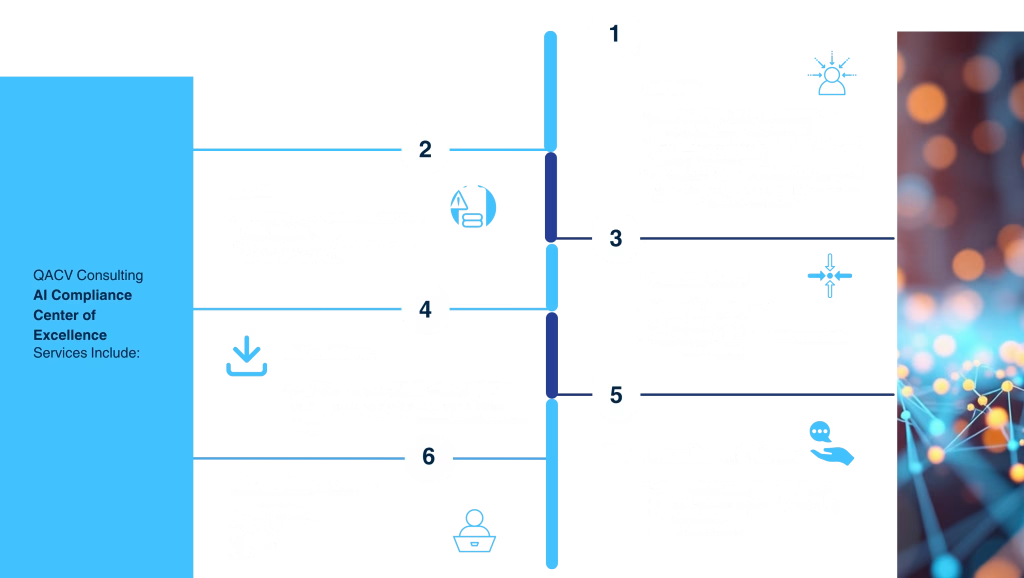
Across two sessions—held in September—participants explored:
For QACV Consulting, this engagement reflects both industry leadership and growing recognition of the firm’s expertise in AI compliance. As organizations navigate the intersection of innovation and regulation, QACV’s structured, risk‑based approach is helping shape how the life sciences sector—and now FDA OSI—evaluates and governs AI technologies.
This landmark training underscores QACV’s commitment to advancing safe, reliable, and compliant AI use across the clinical research ecosystem and all GxP Compliance areas.
SEPTEMBER
2026
INTRODUCING
eQMS-as-a-Service
for small to mid-size
companies
Ensuring compliance
with all applicable regulations

Why eQMS-as-a-Service? Smaller companies often lack the resources to implement a compliant eQMS and rely on tools like SharePoint or network folders for their QMS. QACV’s eQMS-as-a-Service provides a scalable, cost-effective, and compliant alternative.
QACV Consulting partners with Simploud to deliver clients the eQMS-as-a-Service offering. QACV’s clients can securely access the eQMS-as-a Service platform as part of their quality and compliance services, enabling real-time visibility into quality processes, controlled access to relevant documentation, improved oversight, and enhanced audit readiness.
Learn more about how we can support your organization. Partner with QACV Consulting to strengthen your quality systems and ensure regulatory compliance. Contact us for a free demonstration I contact@qacvconsulting.com
JUNE
2026
Maiko Nakazato
Project Manager Administrator / APAC OPERATIONS
Maiko Nakazato is a Project Management Administrator with experience supporting GxP-regulated activities in a global pharmaceutical environment, including audit support, documentation coordination, contract and invoice management, metrics reporting, translation support, and cross-functional communication.
Her experience in project administration, operations support, stakeholder coordination, and English-Japanese documentation support, combined with a detail-oriented approach and practical operational support, will help facilitate efficient project execution, global team coordination, and customer satisfaction at QACV Consulting.
Based in Japan, Maiko supports our APAC operations, and we’re excited to welcome her to QACV Consulting team.

march
2026
Rachel Narino
QA Lead | Sr. Compliance Consultant
Rachel is a Quality Assurance and Clinical Compliance leader with over 13 years of experience in FDA-regulated clinical research environments. As QA Lead and Senior Compliance Consultant at QACV Consulting, she provides strategic oversight of Quality Management Systems, GCP audit programs, CAPA management, and regulatory inspection readiness across global clinical operations.
Rachel has extensive experience conducting and overseeing risk-based GCP, GCLP, and bioanalytical audits across investigator sites, CROs, vendors, laboratories, and internal QMS functions. She specializes in data integrity, documentation compliance, deviation and CAPA oversight, and aligning quality systems with ICH, FDA, and EU regulatory requirements.
Known for her attention to detail and collaborative leadership style, Rachel is committed to delivering compliant, inspection-ready, and high-quality results that strengthen client confidence and operational performance.

february
2026
celebrating 25 years OF EXCELLENCE

Entering a new era of Quality, Innovation
and Leadership
Overview by Chris Wubbolt, M.S. QACV Consulting CEO I Principal Consultant
On January 22, 2026, QACV Consulting celebrated our 25th anniversary. It’s been quite the journey—from starting as a single consultant to building an outstanding team and becoming a globally recognized consulting organization with over 80 highly qualified and experienced consultants supporting clients, large and small. QACV Consulting has never had a business development plan or a sales team; instead, we have remained focused on providing practical, personable, high-quality consulting services. This was our approach in 2001 and remains our approach today—shaped by our culture, our internal team, and the processes and methodologies we have built. Our growth has been the result of consistently doing the best job we can, maintaining collaborative partnerships with our clients, and earning trust through the quality and integrity of our services.
QACV Consulting is a different organization today than we were 25 years ago. As we have expanded our global consultant and partner network, we have developed a strong onboarding program that reinforces our culture, processes, and expectations for how we conduct ourselves professionally with clients, partners, and associates. These onboarding and management processes ensure that our clients continue to receive the same high-quality consulting support that has defined QACV for the past 25 years.
We have also implemented tools that provide greater transparency to our clients regarding the status of projects and activities. As we continue to evolve, we are marking our 25th anniversary by transitioning from a traditional consulting firm to a Quality Management Organization™, partnering more closely with our clients to align with their values, expectations, priorities, and strategic initiatives. Over the past 25 years, we have had the opportunity to support a wide range of life science organizations across the globe and throughout all phases of development and commercialization.
QACV Consulting has steadily expanded its services across GCP, GMP, GLP, GVP, and eSystems, as well as data integrity and quality system development. In addition, QACV Consulting is expanding its service offerings to include our Artificial Intelligence Compliance Center of Excellence and our new eQMS-as-a-Service solution, designed to provide scalable, compliant support for smaller organizations. We have also established global partnerships to further enhance our capabilities, including providing Qualified Person support within the EU. QACV Consulting is also on track to achieve ISO 9001 certification in 2026 through continued enhancement of our internal Quality Management System.
I would personally like to thank all of our clients and partners we have had the privilege to meet, collaborate with, and support over the years. It is truly one of the most rewarding aspects of consulting to help organizations grow, advance their clinical programs, achieve successful regulatory approvals, and overcome complex regulatory and compliance challenges. I also want to thank our exceptional and dedicated management team and consultants, who consistently go the extra mile to meet and exceed client expectations. While QACV Consulting has implemented and supported many robust systems, processes, and methodologies, I often remind our team that “we can always get better.” This commitment to continuous improvement is fundamental to who we are. We have achieved a great deal over the past 25 years, but we are not done yet—we will continue to grow, evolve, and strengthen our capabilities in the years ahead.
With sincere appreciation,
Chris Wubbolt CEO I Principal Consultant
“We are expanding our portfolio of services as we evolve into a Quality Management Organization (QMO™)”
Chris Wubbolt , CEO I Principal Consultant
NEW |
QACV Consulting 2026 Portfolio of Services

GxP Services & Auditing
GxP services including Auditing Services such as:

Data Integrity Programs
Data Integrity Programs, Training, Assessments, and Remediation:

CSV Support
Computer Systems Validation Support, including:

Training Programs
Training Programs and
Courses include:
Leading the future of proactive, intelligent, and global quality
february
2026
Robert J. Wherry, MSc, MS, CPIP
Vice President, AI Compliance Innovation
We are pleased to warmly welcome Robert Wherry to the team as Vice President of our New AI Compliance Center of Excellence.
Mr. Wherry has 42 years of international pharmaceutical, biotechnology and medical device experience with expertise in Quality Systems, Design Control,Computerized System Validation, Data Integrity Audits & Remediation, Quality
Systems, Process Validation, Aseptic Processing, Regulatory Operations and eCTD submissions. Bob is a chemical engineer (Lehigh University), with a MSc in Pharmaceutical Quality (University of Strathclyde) and a MS in Regulatory Affairs (Northeastern University). He has also studied artificial intelligence and machine learning at MIT.
Bob provides compliance consulting services including quality system design, gap assessments, mock inspection audits, vendor audits, data integrity assessments & remediation, computer validation, GxP compliance assessments and training, process development and process validation, CMC & Module 3 assessments, regulatory strategies, and compliance approaches for artificial intelligence and machine learning.

AUGUST
2025
Penny Jegede
Sr. Compliance Consultant (GVP, eSystems)
With over 30 years of experience in clinical research, pharmacovigilance, IT compliance, and quality assurance, Penny brings unmatched regulatory expertise and leadership to our team.
Her distinguished career includes roles at Johnson & Johnson, Merck, and Pfizer, with a strong focus on GCP and PV audits, Computer System Validation (CSV), and global Quality System assessments. At QACV Consulting, Penny leads End-to-End (E2E) PV audits, serves as an IT/CSV Subject Matter Expert, and provides advanced regulatory training on topics like AI/ML in GxP systems and CSA principles.
She is widely recognized for her innovative work in risk-based auditing, particularly in pharmacovigilance IT systems. Her expert presentations—such as “Auditing a GxP System with an AI/ML Component” and “E2E Audit Management for IT Suppliers”—reflect her deep understanding of evolving regulatory landscapes.
Penny’s ability to combine strategic oversight with technical detail makes her a trusted advisor to clients and colleagues alike. Her commitment to excellence continues to ensure QACV Consulting delivers high-impact, inspection-ready compliance solutions worldwide.
AUGUST
2025
Melanie Willis
Sr. Compliance Consultant (GCLP, GLP Adviser)
We’re pleased to share positive recognition for an exceptional audit performance from a recent project conducted by QACV Consulting GCLP/GLP Sr. Compliance consultant Melanie Willis.
Following her excellent audit work with our GLP client, they have expressed satisfaction with her professionalism and expertise. As a result of her thorough evaluation, additional on-site follow-up is being scheduled to further assess the scope of the findings.
Our GLP client has requested Melanie’s continued support during the next phase of the project, a clear reflection of the trust and value she brings to our compliance services.
At QACV Consulting, we take pride in delivering meaningful, actionable insights—and we’re proud to see our consultants making a lasting impact.

May
2025

by Chris Wubbolt
QACV Consulting CEO I Principal Consultant
During a recent audit, a thoughtful question was raised by one of our consultants regarding the classification of an observation:
Observation: Tubes for clinical pathology (Hematology, Coagulation, and Chemistry)
were stored in an office rather than in a temperature-controlled environment.
Question: Does this constitute a Major finding that could affect test reliability—or can it be considered Minor if informal controls (e.g., temperature monitoring) are in place?
Key Takeaway:
“It’s not always black and white”
As Chris emphasized, “Findings like this often require supporting information and judgment.
It’s not just about where the tubes were stored—it’s about whether the storage conditions met validated specifications.”
He also shared a broader reflection from a past debrief:
“I once classified a finding related to a non-critical system that hadn’t been validated as Major. A client QA rep argued that any system not validated should be a Critical finding.
I explained that if the system is non-critical, it can’t reasonably rise to that level. Everyone agreed—context and classification nuance are essential.”
Chris Wubbolt Response:
“It Depends—Follow the Manufacturer’s Requirements.”
Chris began by pointing out that the critical factor is manufacturer storage specifications:
“Some hospitals or clinics do store tubes outside of controlled areas, but it comes down to what the manufacturer states as acceptable storage conditions. For example, certain hematology tubes might even require refrigeration.”
He referenced two key regulations:
If the tubes were not stored according to manufacturer requirements, this could justify a Major finding. However, context matters.
“If temperature logs show that conditions have stayed within acceptable ranges—even in a non-controlled room—then the observation might be considered Minor,” Chris advised.
Final Thoughts
Before classifying a finding as Major, ensure the following:
april
2025

by Angela Haan
GCLP/GLP Adviser | Sr. Compliance Consultant
While there have been no changes to the GLP regulations in recent years, proposed revisions and comments are still under review with no expectation for issuance. However, we may see the FDA issue or revise guidelines to better align with international standards, such as those from the OECD.
Compliance to GCLP is often focused on compliance with international standards and harmonization with other regulatory bodies (such as FDA, EMA, and ICH and industry best practices).
Common compliance issues impacting GLP and GCLP laboratories include emphasis on Data Integrity, effectiveness of the Quality Management System, Technological Integration, Continuous staff training, Adoption of Risk-Based Approaches, Global Harmonization Efforts, and Adaption to Emerging Technologies.
1. Emphasis on Data Integrity:
Regulatory bodies are increasingly prioritizing data integrity.
Laboratories must ensure that all data generated is accurate, reliable, and traceable. This includes stringent documentation practices and audit trails.
2. Effectiveness of Quality Management System:
Inspections of GLP and GCLP laboratories are becoming more thorough, with regulators emphasizing compliance with standards and the effectiveness of Quality Management Systems (QMS).
3. Technological Integration:
There is a growing trend towards integrating digital solutions, such as electronic lab notebooks and automated data management systems, to improve efficiency and ensure compliance with regulatory standards.
4. Continuous Staff Training:
There is a strong emphasis on the ongoing training of laboratory personnel. Regulatory bodies require that staff remain updated on GLP and GCLP practices to ensure that staff are knowledgeable and compliant with current practices.
5. Risk-Based Approaches:
A trend toward risk-based approaches is evident, allowing laboratories to focus resources on critical aspects of studies that significantly impact outcomes.
6. Global Harmonization Efforts:
Regulatory agencies are collaborating to harmonize GLP and GCLP guidelines across regions. This initiative aims to streamline processes for international studies and foster a consistent regulatory environment.
7. Adaptation to Emerging Technologies:
As scientific advancements, particularly in personalized medicine and genomics, emerge, regulatory bodies are updating guidelines to address the implications and challenges these technologies present for GLP and GCLP compliance.
For more information, we recommend checking the FDA’s website for the latest guidance documents and regulatory changes and webinars related to GLP and GCLP.

Summary of
Trends in FDA 483
warning letters for GLP
and GCLP Laboratories
Training and Competency:
Several warning letters pointed out deficiencies in training protocols, emphasizing the need for comprehensive training for staff to ensure compliance with GLP and GCLP standards.
Equipment Calibration and Maintenance:
Many laboratories failed to adhere to proper calibration and maintenance schedules for critical equipment, which could compromise the reliability of results.
Data Integrity Concerns:
Numerous laboratories were cited for issues related to data integrity, including inadequate documentation practices and failure to maintain complete records.
Quality Control Measures:
Non-compliance with quality control procedures was a recurrent theme, with labs being found lacking in proper validation of analytical methods and controls.
Protocol Deviations:
Instances of unreported deviations from approved protocols were noted, raising concerns about adherence to study plans.

FDA WARNING LETTER
A warning letter issued by the FDA to Applied Therapeutics, Inc. on December 3, 2024.
The letter details violations related to the company’s clinical investigations and compliance with FDA regulations.
The FDA raised concerns about the company’s inadequate oversight of clinical trial procedures, failure to properly monitor study sites, and deficiencies in reporting adverse events. The FDA demands that Applied Therapeutics take corrective actions to address these issues, including ensuring compliance with GCP standards and submitting a detailed plan for remediation. Failure to address these violations may result in further enforcement actions.